Tale: Charlemagne's Dream, or How Ingelheim got its Name
The Kaiser’s Dream at Ingelheim
German Geography and History
The name, Charlemagne, describes the leader of a Germanic tribe, called the Franks. Charlemagne’s Pfalz or palace in Ingelheim is one of the town’s oldest and most remarkable attractions. And Charlemagne’s story allows us a view into 2,000 years of Germany’s history.
The first record of a Volk known as “Germans” was written by Julius Caesar who waged battles against German tribes as he completed his conquest of Gaul (France) in 50 BC. Julius’s last name, “Caesar,” would later be appropriated by his grand-nephew and heir, Octavian, who adopted the name “Augustus Caesar.” The name, Caesar, was later appropriated by emperors in Germany, Kaiser, and in Russia, Tsar. These terms mean, Caesar, in their languages.

By the time of Augustus, the borders of Rome’s empire had pushed all the way to the Rhine and the Danube rivers. Along the Rhine, Rome established several settlements, including Colonia (Cologne) and Mogontiacum (Mainz), both of which lie on the west bank or “Roman side” of the Rhine.
The Romans’ efforts to push beyond the Rhine and conquer the land west of the Elbe, a huge river that flows right through the middle of Germany, from present-day Dresden to Hamburg, were crushed in a battle in 9 AD in the Teutoburg Forest, where three entire legions of Roman soldiers were wiped out in an ambush by German warriors led by a leader called Arminius by the Romans, Herrman, by his fellow Germans.
The Romans fortified the Rhine, and it remained the border between the Roman Empire and Germanic tribes for another 400 years. Another German river, the Danube, which flows eastward, all the way from the Black Forest to the Black Sea (vom Schwarzwald bis zum Schwarzes Meer) marked another important Roman border. But we know that eventually a succession of German tribes, with names like Vandals, Allemanni, Swabians, and Goths, among others, broke through the Roman frontier. The Vandals moved through Spain into northern Africa. The Visigoths ravaged the Mediterranean Coast and conquered Rome in 476 AD.

If you look closely at the map, “Invasions of the Roman Empire 100-500CE,” you will see an orange line that marks the migration of the Franks, a tribe based in the region of the Middle Rhine (towns that have “-heim” in their names, such as Mannheim or Ingelheim often have their origins in Frankish settlements). The Franks would move into northern France, which takes its name from that Germanic tribe. The German name for France, even today, is Frankreich, means “kingdom of the Franks.”
The name we use in English for the Franks’ greatest king comes from the French: Charles le Magne means 'Charles the Great.' The Germans know him as “Karl der Große.” For this tale I will refer to him the way I have heard his name spoken in Ingelheim: Kaiser Karl.
In the late 700s Kaiser Karl pushed the borders of this frankish Reich southward and eastward, pushing through modern France to its southern border with Spain. He would cross the Pyrenees Mountains, which mark that border, but he was unable to conquer the Arab Moors, who ruled Spain at the time.
In the east, Kaiser Karl, pushed the powerful Saxon tribe east of the Elbe River and on beyond the Oder River, which marks the present-day boundary between Germany and Polen. One tool that he used to justify his invasions and link his widespread empire together was Christianity. The Saxons, who refused to give up their worship of Odin, Loki, and Thor, were ruthlessly put down and forced to convert as one or face massacre.

And in the south, Kaiser Karl crossed the Alps and pushed southward towards Rome, where Pope Leo III had called for his aid (the illustration above shows Karl arriving in Rome to help the Pope). Karl arrived just in time, rescuing Leo from a mob that planned to rip out his tongue and put out his eyes. On Christmas Day, 800, as Kaiser Karl prayed in St. Peter’s Church in Rome, a grateful Leo appeared an put a crown on his head

From this time onward, Kaiser Karl was known as an ordained or “holy” Emperor. And since his empire was the largest one Europe had seen since the Romans, the kings who followed Kaiser Karl, tried to draw attention to his accomplishments. One hundred fifty years after Karl’s death, when Otto I sought to claim Karl’s domain, he called his Reich, the heiliges romisches Reich (see map above).
The Holy Roman Empire, which traced its origins to the crowning of Kaiser Karl in 800, would endure for 1000 years, until the Battle of Austerlitz in 1805, when Napoleon’s victory would temporarily turn many of the German duchies into republics and force the final Kaiser, Franz II, to abdicate his throne.
Another phrase that describes the Holy Roman Empire is das erste Reich, the first empire. Ein zweites Reich would emerge in 1871, when a new German Empire emerged under a new Kaiser (Wilhelm I), and would last until Germany’s defeat in World War I brought in a republic.
You may have heard of a Third Reich, ein drittes Reich, that some crazy, nationalistic political party concocted in the 1930s. They claimed that their empire would last 1,000 years (just like the first Reich), but it endured only twelve terrible and bloody years, 1933-45.
So there you have a 2,000-year-history of Germany, beginning with two Caesars (Julius and Augustus), and moving through a number of Kaisers (Karl, Otto, Franz and Wilhelm) to the Federal Republik of Germany today--a republic being a land ruled by a constitution, not a Kaiser.
The Tale
Now let’s see if a legend can teach us more about Kaiser Karl and about Ingelheim, the home of his Kaiserpfalz, and our home for three and a half weeks next summer.
Kaiser Karl traveled from place to place throughout his empire, bringing rebellious counts to heel and ensuring loyalty across his vast domain. Because he traveled with such a large retinue--and because he was constantly traveling--he had not yet found a place to build a permanent palace. One night, camping near the Rhine, he had a peculiar dream: an angel appeared and ordered him to rob the lord of a nearby castle. If he failed to do this, the Engel said, his life and his kingdom would be in peril.
Kaiser Karl awoke and looked around. The Rhine gurgled in the distance, but there was no other sound. Robbing a castle seemed strange to Kaiser Karl, the most powerful man in the Franken Reich. He went back to sleep, only to be woken twice more by the angel, who urged him to pursue his mission or face a certain death.
Finally Kaiser Karl got up, saddled his horse quietly, and rode out along the river to Burg Windeck in the village now known as Heidesheim. As he rode along in the dark, he felt some danger. The roads of that era often hid thieves, and riding alone in the dark of night held no guarantees of safety.

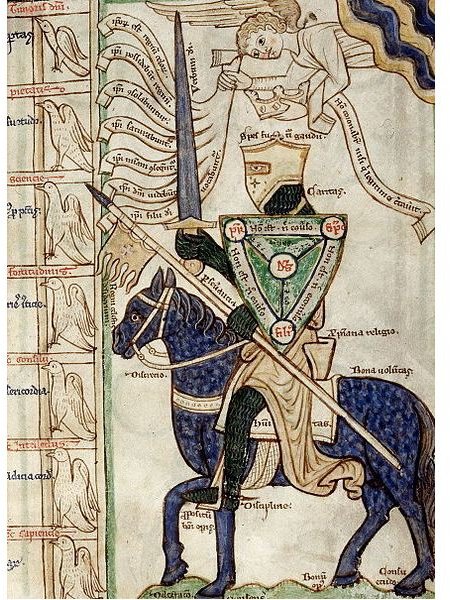
The Kaiser must have felt some Angst when a shadow emerged from the forest. A knight in black armor rode and fell into pace by the Kaiser’s side (see illustration, right).
Two figures now rode silently along the Rhine. A Kaiser and a black knight. The Kaiser’s hand reached toward his sword. Was this a knight or a robber? Even if he were the latter, had not Kaiser Karl himself been sent on this midnight mission by ein Engel to steal from the castle? Was he not a robber himself?
"Who lives in yonder Burg?" Kaiser Karl asked the knight. "Count Donauwirt of Heidesheim," came the reply.
"This very night will I take from him his most precious possession," said the king.
"Mean you the jeweled goblet he keeps by his bedside, from which he sips wine all the day long?"
"That very one," said the king, still wondering the identity of his mysterious co-rider."
The black knight reached out and touched Karl’s arm. “Allow me to steal the goblet,” he told the Kaiser. “I know secret way up the wall of this castle. And I have sworn vengeance on Count Donauwirt. The theft of the goblet will settle a score between us.”
“May I know your name?” the Kaiser asked.

“Should I return with the goblet, we will go together to your camp, and I will tell it to you after you have had a full night’s sleep,” the Black Knight replied (In the image above, a woman presents a goblet to an elderly knight as he takes a warm bath).
In truth, the knight was a young man named Elbegast, who had a history with Kaiser Karl. On Karl’s last visit to this part of the Rhine, Count Donauwirt had falsely accused Elbegast of theft. Based on this false testimony, Karl had stripped Elbegast of his family lands and had given them to Count Donauwirt.
The two horses paused in the shadow of the tower wall. The Black Knight slipped into the darkness, scaled the wall, and made his way into the room of Count Donauwirt. The goblet lay on a table next to the bed, still half full of Rotwein. As the Black Knight took the jeweled goblet from the bedside, a hound began to bark outside. The Black Knight retreated into the shadows, as Count Donauwirt called out,
“Robber!” The count called out. "Mein Schwert, my sword!"
His wife,, tried to comfort him. She was a very powerful woman in her own right, a young niece of Kaiser Karl.
"Hush, Dear," the countess consoled her husband. "You have not slept well these many nights, Was ist los?"
There in the darkness, with the the black knight just a meter away, Count Donauwirt told his wife of a plot to assassinate Kaiser Karl the next day. A band of assassins would attack the king at court, giving the Reich to Count Donauwirt and splitting the Kaiser's money amongst themselves.
Hidden so close, the black knight wished for his sword to murder the traitorous count right then and there. But he held the half-full goblet in his hands. And his mission was to deliver it back to the Kaiser, whom he had recognized on the ride along the riverside.
“Nie!” cried the countess to her husband. “You shall not murder my uncle.”
“I do what I want,” the count sneered. And he made his hand into a fist and struck the face of his lovely young wife, who cried out, then collapsed unconscious, blood streaming from her nose onto an embroidered pillowcase of soft green silk.
The countess's cry awakened the servants, whose steps were heard on the ladder outside the room. The count arose and told them to search the castle for a robber, taking his sword from his bedside, and running toward the steps that descended to the main hall. Behind him he left his wife, her bruised face turned toward the wall, bleeding into her pillow.
The Black Knight emerged from the shadows after the count left. He walked over to the countess's side, checked to see if she was breathing, and moved her into a more comfortable position on the bed. Before he left, he took the bloody, green pillowcase to take as evidence back to the Kaiser.

As Graf Donauwirt searched through the rooms of the castle, the black knight carefully climbed down the outside of Burg Windeck and returned to the king, delivering the goblet and the pillowcase. When he revealed Count Donauwirt’s treacherous plot, as well as his abuse of the Kaiser’s niece, Kaiser Karl nodded, remembering the Angel's warning in his dream: “If you ignore me, you face certain death!” (Pictured above: Burg Windeck is a two-mile hike from the Kaiserpfalz).
"Come to my camp tomorrow," Kaiser Karl said, "I shall sleep. You will give me your name. And all will be made right."
The next day, when Count Donauwirt and his men arrived at Kaiser Karl's camp, they were searched by the Kaiser’s most loyal soldiers. Weapons were found. They were condemned for treason and put to death.
Kaiser Karl called for the Black Knight, who had arrived at the camp shortly after Count Donauwirt and his band of assassins. “Who is this knight who aided me last night, and saved my life and with it all of the vast Frankish Reich?” the Kaiser asked.
“I am Elbegast,” the knight replied, “A night stripped of his lands but faithful to Kaiser and Reich.”
“You will be landless no longer,” the Kaiser said. He rewarded Elbegast with Burg Windeck, all of Count Donauwirt’s lands, a marriage to the Kaiser’s niece (so terribly abused by the traitor), and even the jeweled goblet, which remains in Hildesheim to this very day.

And the place where Kaiser Karl had his dream--where three times an angel warned him to arise. He built a palace there, a Pfalz, and he called the place, "home of angels," Ängelheim, or as it is known today, Ingelheim, a beautiful town on the Rhine. (Above: the grass marks the floor of the throne room of the Kaiserpfalz, which you will visit in Ingelheim next summer.)


Comments
Post a Comment